Think · 11 October 2026 · 3 min read
Sixty paper hats on a table in Bridlington: David Smith and the shape mathematicians had sought for decades
David Smith, a retired print technician in East Yorkshire, likes jigsaws, fractals and road maps, and says he was not great at maths at school. In November 2022 a shape he was playing with on his computer began to tile in a way he had not seen before. He cut it out of card, sixty times, and then he emailed someone who could test it.
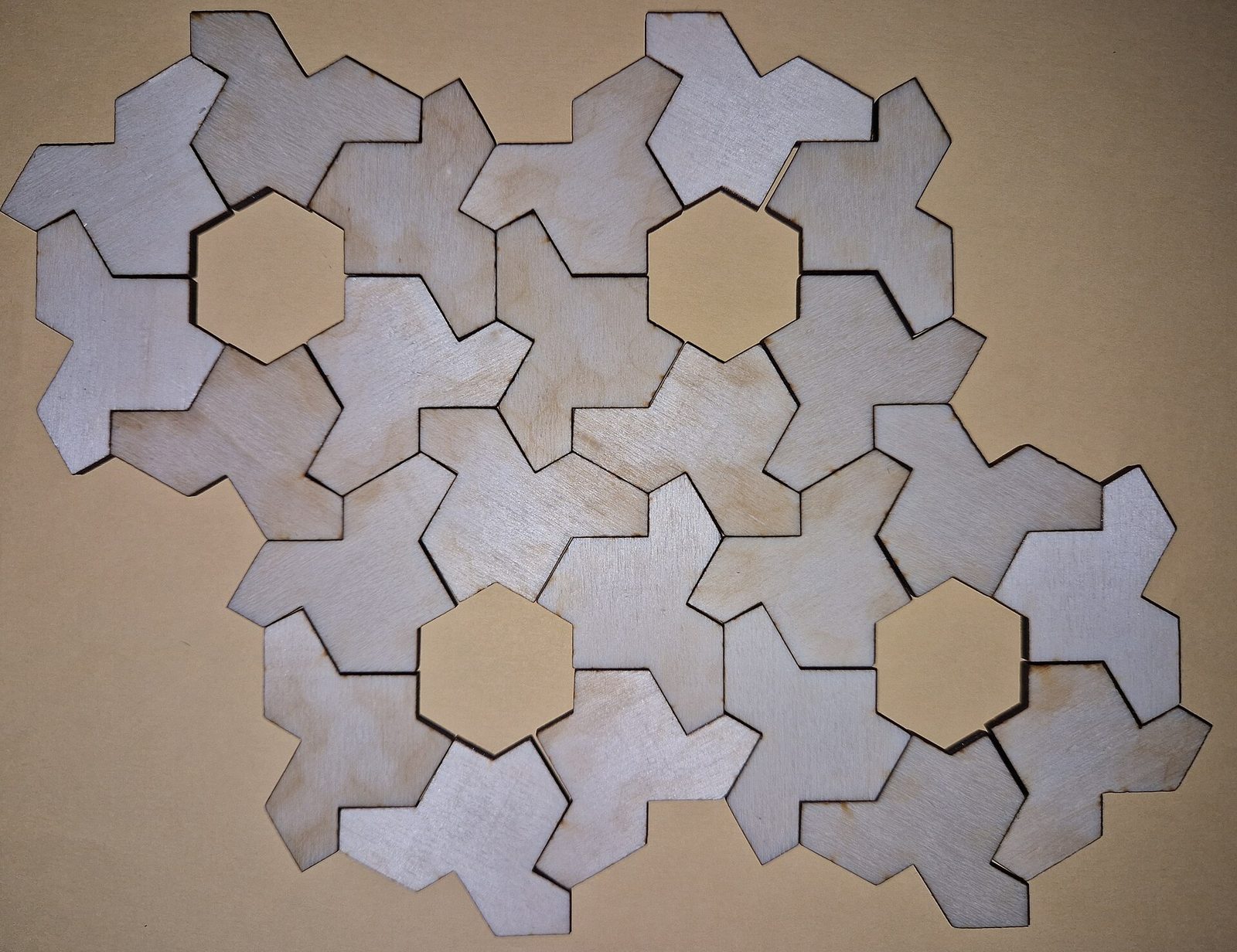
The shape has 13 sides and no symmetry, and it is known as the hat. In November 2022 there were sixty of them, cut from card, spread across a table in Bridlington, a seaside town on the Yorkshire coast of England.
David Smith had cut out thirty and fitted them together, then thirty more. Smith, who was 64 when the news agency AFP interviewed him the following June, is a retired print technician. Quanta Magazine, which reported the discovery in April 2023, described him as a fan of jigsaw puzzles, fractals and road maps. He told AFP that he “wasn’t great at maths at school”.
He had been trying shapes in a piece of software called PolyForm Puzzle Solver, as he often did, to see how each one covered the screen. This one fitted together without gaps. It also refused to settle into a pattern.
“I noticed that it was producing a tessellation that I had not seen before.” — David Smith, to Quanta Magazine
The email
Card could only take him so far. A table is finite, and the question was about for ever: whether the shape would go on covering a flat surface without the pattern once repeating.
Smith knew someone who could test it. He and Craig Kaplan, a computer scientist at the University of Waterloo in Canada, had for years belonged to the same email list for people interested in tiling. Kaplan had written software for a related problem. According to the university’s account, Smith asked him to run the shape through it and see what happened.
Kaplan’s program surrounded the hat with ring after ring of copies. By the middle of January 2023 two more people had joined: Chaim Goodman-Strauss, a mathematician, and Joseph Samuel Myers, a software engineer in Cambridge, England. Myers had a proof within about a week, Quanta reported. The four announced the result on 20 March 2023.
“It’s a tricky little tile.” — David Smith, to Quanta Magazine
Less than a week after that paper appeared, AFP reported, Smith emailed Kaplan another shape. The hat needs some tiles turned over. The new one, named the spectre, does not.
Why this matters
Mathematicians call such a shape an “einstein”, a pun on the German for “one stone”. The search for it had been narrowing for a long time. In the 1960s Robert Berger built a set of tiles that could only form non-repeating patterns, and it needed 20,426 different shapes. In the 1970s Roger Penrose got the number down to two. Nobody could find one.
“The answer fell out of the sky and into the hands of an amateur.” — Craig Kaplan, to AFP
It did not fall on just anyone. Smith had looked at enough tilings to know when one was strange, and he knew who to ask. The paper, with his name first among four authors, was published in the journal Combinatorial Theory in June 2024. Writing about the search in 2025, Kaplan credited an observation of Smith’s, about a shape they had earlier set aside, with leading to the spectre.
Put the hat on your own table
Nothing Smith used is out of reach, and most of it is free.
- Start on a screen. Kaplan’s hat page links to a Mathigon polypad where you can move virtual hats by hand, and to a browser app that builds patches of them and saves the result as a picture.
- Then use card. Print a patch, cut the tiles out and push them around. The page also points to outlines made for laser cutters and 3D printers, if you know someone with one.
- Ask. He could not settle the question alone and did not try to. The proof came from people he reached by email.
If you like a puzzle with an answer at the end of it, there are four new ones every day on our puzzle page. And for another find that began as a hobby, read how Peter Kaestner became the first person to see 10,000 species of bird.
Sources
- Hobbyist Finds Math's Elusive 'Einstein' Tile — Quanta Magazine (Erica Klarreich), 4 April 2023
- UK hobbyist stuns maths world with 'amazing' new shapes — Agence France-Presse, carried by Raw Story, 10 June 2023
- Trick of the hat: finding the elusive 'einstein' tile — University of Waterloo, Cheriton School of Computer Science, 13 April 2023
- An aperiodic monotile (the paper, the browser apps and the tile outlines) — Craig S. Kaplan, University of Waterloo, opened 11 October 2026
- The Path to Aperiodic Monotiles — Craig S. Kaplan, arXiv (first printed in Eureka, issue 67), 2 September 2025
Quotes are taken from the sources above. We link to the original reporting so you can read the full story.
Was this one for you?