Curious · 12 November 2026 · 4 min read
One bag, 72 days and a race she did not know about: Nellie Bly's trip around the world
In November 1889 a New York reporter set out to beat Phileas Fogg's fictional 80 days. A rival magazine sent a second woman the other way the same afternoon, and nobody told her.
At 9.40 on the morning of Thursday 14 November 1889, the German steamer Augusta Victoria left Hoboken, New Jersey, for Southampton. On board was a reporter from the New York World with a satchel 7 inches tall and 16 inches wide. She had bought it the day before. Two evenings earlier, according to the Heinz History Center in Pittsburgh, her editor had told her she was going around the world.
Her name was Nellie Bly, and her target was Phileas Fogg, the hero of Jules Verne’s novel, who had done it in 80 days.
The reporter
Nellie Bly was a pen name. She was born Elizabeth Jane Cochran on 5 May 1864 at Cochran’s Mills, Pennsylvania, a town her father had founded; the New-York Historical Society says she later added an “e” to the surname. By 1889 she was famous for stunt journalism, and the World was Joseph Pulitzer’s paper.
The idea had met resistance. By Bly’s own account, quoted by both the Heinz History Center and Smithsonian Magazine, she was told a man should go instead, and answered: “Start the man, and I’ll start the same day for some other newspaper and beat him.” That exchange comes from her own retelling, so treat it as her version.
What went in the bag
The New-York Historical Society says she took only the dress she wore, a cape and a small bag. The Heinz History Center quotes her list, which included two travelling caps, three veils, a pair of slippers and a jar of cold cream. PBS’s American Experience film adds £200 in British money, some American money taken “as an experiment”, and a 24-hour watch.
A detour to Amiens
In London the World’s correspondent told her that Verne had asked to meet her. Seeing him meant a detour to Amiens and a night-time scramble for the mail train to Italy. PBS says she shared wine and biscuits with him; the Heinz History Center says he asked why she would not cross India by rail, as Fogg had. Smithsonian Magazine reports that he wished her luck: “If you do it in seventy-nine days, I shall applaud with both hands.”
From Brindisi she sailed through Port Said, Aden, Colombo, Penang and Singapore to Hong Kong, then to Japan and across the Pacific on the Oceanic.
The race she did not know about
On the day Bly sailed, John Brisben Walker, owner of Cosmopolitan magazine, sent for one of his writers, Elizabeth Bisland, 28. The Heinz History Center says it took an hour’s argument to persuade her, and that she left for Chicago at 6pm, heading west. She later wrote that she had been “practically stupefied with astonishment”.
Bly found out in Hong Kong. Smithsonian Magazine says a shipping clerk told her that the other woman had left three days earlier. She did not change her plan. Bisland’s luck turned on a rough crossing home from England, and Smithsonian says she arrived four days after Bly.
The finish
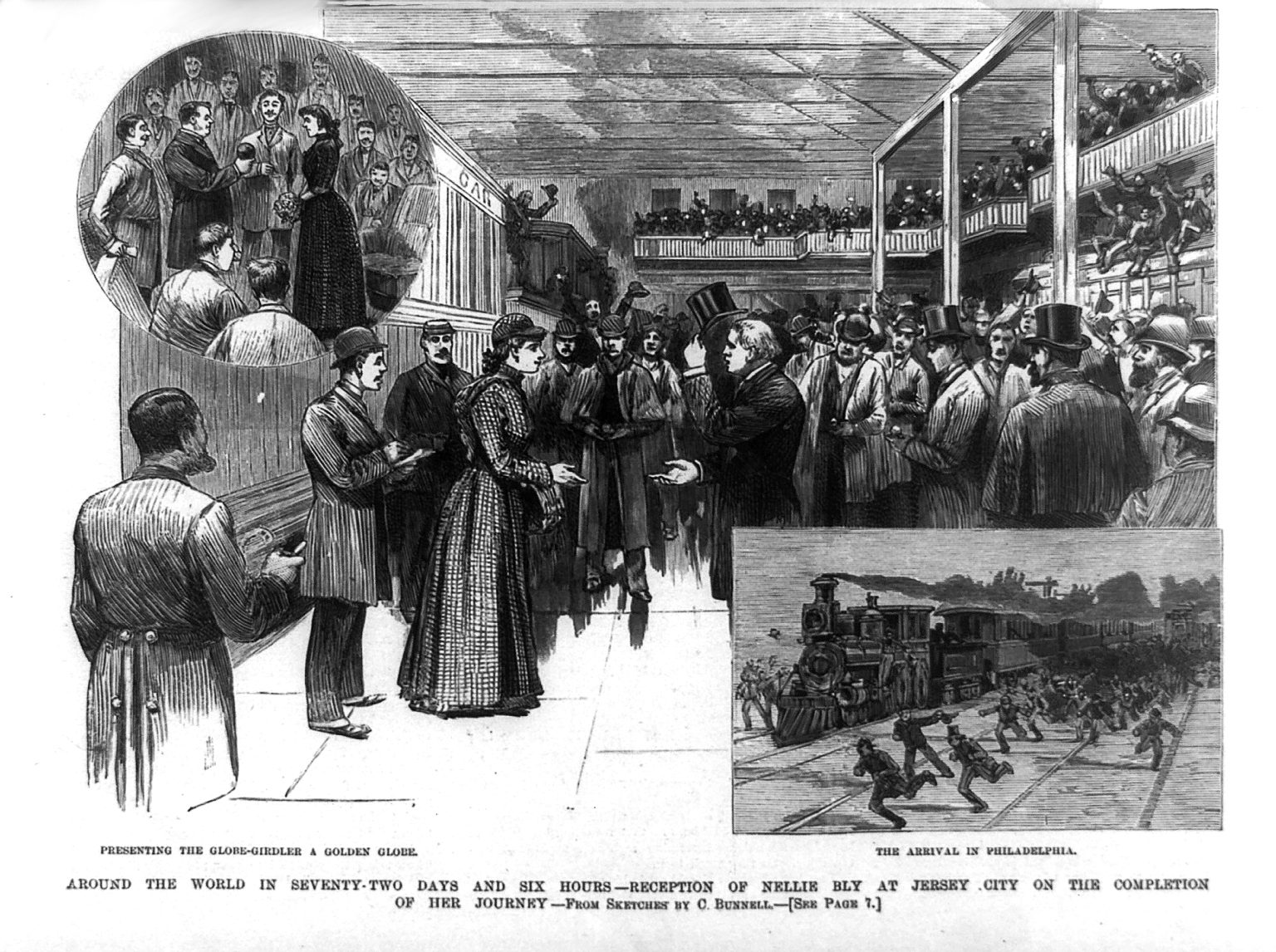
The Oceanic reached San Francisco on 21 January 1890. The World chartered a train across the country, and crowds met it at stations. Bly arrived at Jersey City on 25 January, 72 days, 6 hours and 11 minutes after she left. She had covered nearly 25,000 miles.
Where the accounts differ
- The final time. The Heinz History Center stops at minutes; PBS adds 14 seconds.
- The Atlantic. PBS gives the crossing as 6 days 21 hours; Smithsonian says seven days; the Heinz History Center says both “seven days” and “nearly eight days” on the same page.
- Christmas. The Heinz History Center has Bly reach Hong Kong on 23 December and spend Christmas Day in Canton; Smithsonian puts her arrival in Hong Kong on Christmas Day.
- The reward. The Heinz History Center says she got no bonus or rise and left the paper soon after. On PBS, her biographer Brooke Kroeger recounts Pulitzer saying he had given her a very large bonus.
- The clerk’s words. PBS’s version of the Hong Kong conversation is a reconstruction, not a record.
Afterwards
The trip sold a board game, “Round the World with Nellie Bly”, made by McLoughlin Bros in 1890. In 1895 she married the industrialist Robert Seaman and later ran his Iron Clad Manufacturing Company. The New-York Historical Society says that in the First World War she became the first woman to report from the trenches. She died in New York on 27 January 1922. Her record did not last long: by 1913, the Heinz History Center notes, John Henry Mears had gone round in under 36 days.
For another long journey against the clock, read how Frank Worsley steered the James Caird to South Georgia, and for one at sea in a smaller boat, Dave Bell’s row from Peru towards Kenya.
Sources
- Nellie Bly: Around the World in 72 Days — Senator John Heinz History Center (Lawson Pace), accessed 12 November 2026
- Life Story: Elizabeth Cochrane Seaman, aka Nellie Bly (1864-1922) — New-York Historical Society, Women & the American Story, accessed 12 November 2026
- Around the World in 72 Days — PBS American Experience, 1997; accessed 12 November 2026
- Nellie Bly's Record-Breaking Trip Around the World Was, to Her Surprise, a Race — Smithsonian Magazine, accessed 12 November 2026
Quotes are taken from the sources above. We link to the original reporting so you can read the full story.
Was this one for you?