Curious · 24 October 2026 · 4 min read
Through a hole on a hill above Montignac, four friends found the painted cave of Lascaux
In September 1940 an apprentice mechanic and three friends squeezed into a hole above Montignac in south-west France and found walls of Ice Age animals. The cave has been closed to visitors since 1963, but the story of how it was found, dog included, is still being told and retold.
Halfway up the hill above Montignac, in the Dordogne in south-west France, there was a hole that local people called a foxes’ den. A local legend said an underground passage ran from the hill to the Lascaux manor house. Marcel Ravidat, an apprentice mechanic, wanted to find it.
According to the French Ministry of Culture’s Lascaux website, his first attempt stopped because he did not have the right tools. On 12 September 1940 he came back with three friends, Jacques Marsal, Georges Agniel and Simon Coencas. They made the hole bigger, and Ravidat slid down a narrow shaft onto a slope of fallen stones. The others followed.
Thirty metres of animals
By the light of a lamp they had put together in a hurry, the four walked a gallery about 30 metres (100 ft) long and saw the first paintings, in the passage now called the Axial Gallery. The walls were covered in animals. They stopped at a black hole that dropped further down.
The next day they came back with a rope. Ravidat went first down the 8-metre (26 ft) shaft and found what the ministry calls the scene of “the man confronting the bison”. Britannica describes it as a rare scene that tells a story, read by some as a hunting accident and by others as a shamanic scene.
On 18 September the boys told their teacher, Léon Laval, who went into the cave that same day. Two days later the French archaeologist Henri Breuil, who had taken refuge in the area during the war, came to see it. The local tourist office says it was Breuil who called Lascaux the “Sistine Chapel of Prehistory”.
What is on the walls
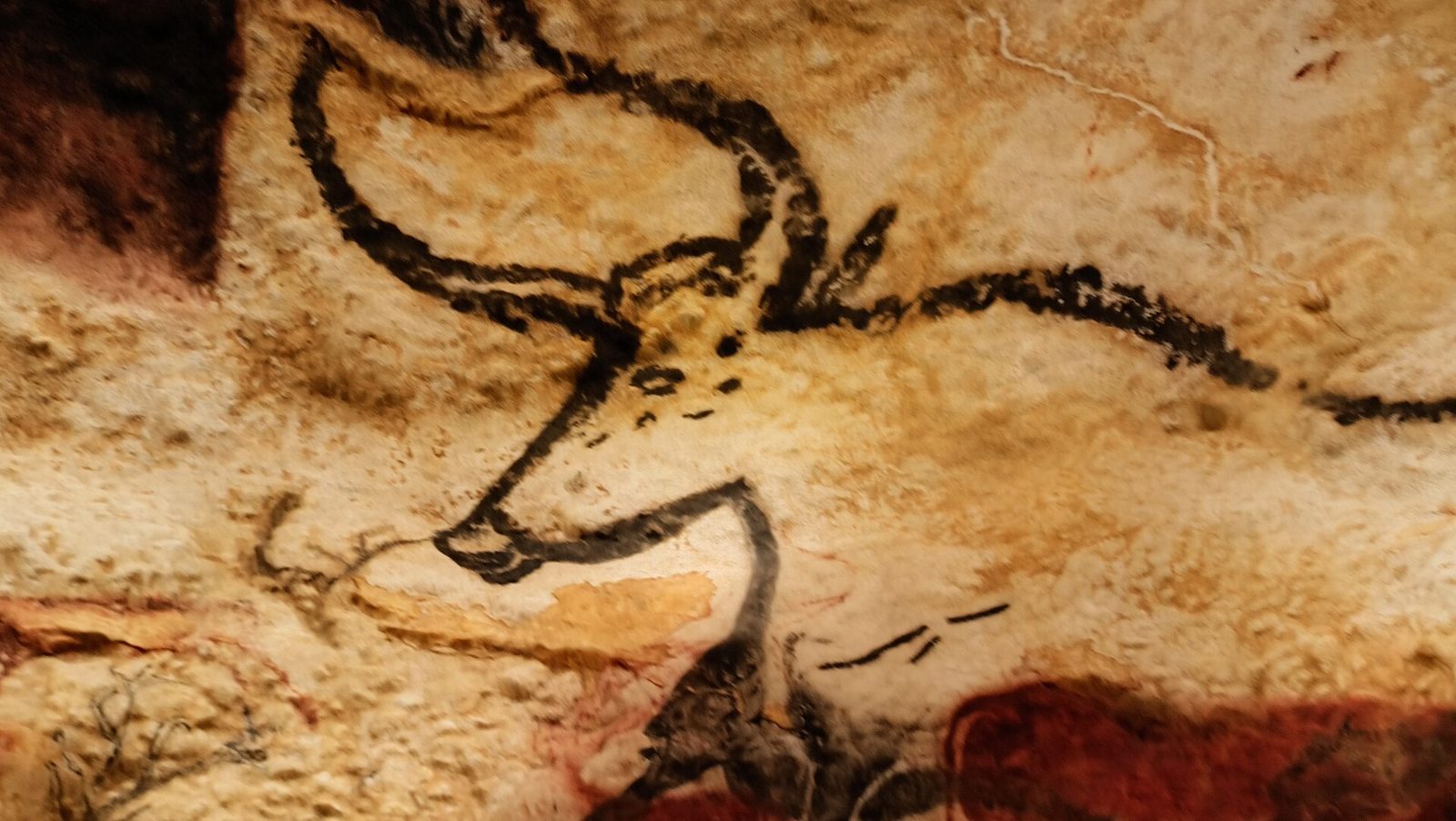
Britannica counts about 600 painted and drawn animals and symbols and nearly 1,500 engravings: horses in large numbers, four huge aurochs (wild cattle) about 5 metres (16 ft) long, red deer, stags that seem to be swimming, bison, a row of cats and a two-horned creature nicknamed the unicorn.
The age depends on whom you read. Britannica gives about 17,000 years, from radiocarbon dating of charcoal. The Ministry of Culture gives 20,000 to 18,000 years, and adds that newer dating of reindeer bones points to 21,500 to 21,000 years.
The dog, and other things the accounts disagree on
Most retellings start with a dog. The local tourist office says that on 8 September Ravidat’s dog, Robot, disappeared into a hole left by a fallen tree, and History Today tells it the same way: Ravidat found the dog at the bottom of a shallow pit and noticed a deep hole nearby. The Ministry of Culture’s own account of the discovery does not mention a dog at all. It has Ravidat going after the foxes’ den and the legend of the tunnel. Robot may well have been there; how much he did is less certain than the retellings suggest.
The ages vary too, even on the same official site. The ministry’s page on the four discoverers gives Ravidat as 17, Agniel 16 and Marsal and Coencas 15. Its page on Simon Coencas says he was born in 1927 and was 13. It also corrects what happened next. Coencas’s family, who were Jewish, had taken refuge in Montignac that June. After a German decree of 27 September 1940 they went back to Paris. In 1942 he was arrested with his family and held at Drancy. The Red Cross secured his release and his sister’s because they were young; other members of his family were murdered at Auschwitz. Coencas returned to Lascaux many times and remembered the cave all his life. “Even today I could almost draw it,” he said, as the ministry records. He died on 2 February 2020, the last of the four.
Loved almost to death
Ravidat and Marsal guarded the entrance through the winter of 1940–41. When the cave opened to visitors in 1948, they became its guides, and in 1958 and 1959 they were the ones who pointed out green algae on the walls. Britannica says visitors, as many as 100,000 a year, and the artificial lighting faded the colours and fed algae, bacteria and crystals. The Ministry of Culture says that in the months before it closed, up to 1,800 people a day went in.
In April 1963 the culture minister, André Malraux, closed it. Marsal became its guardian. Today the original is open for fewer than 200 hours a year in total, and the state spends more than €500,000 a year looking after it. It has been a UNESCO World Heritage site, with the other decorated caves of the Vézère valley, since 1979.
What visitors see instead are copies: Lascaux II nearby, which reproduces the first two rooms, and Lascaux IV at Montignac-Lascaux, a complete reproduction that opened in 2016. The four friends were not reunited until November 1986, 46 years after they slid down the shaft.
For another find made by someone who went back to look properly, read how Jeremy Lockwood found three new dinosaurs in museum drawers, and if you want to do some finding yourself, start with fossil hunting for beginners.
Sources
- The discovery — Lascaux website, French Ministry of Culture, accessed 24 October 2026
- The four discoverers — Lascaux website, French Ministry of Culture (after Société historique et archéologique du Périgord, 1990), accessed 24 October 2026
- Simon Coencas (1927–2020) — Lascaux website, French Ministry of Culture, accessed 24 October 2026
- La grotte de Lascaux, un site emblématique — French Ministry of Culture, DRAC Nouvelle-Aquitaine, accessed 24 October 2026
- Lascaux — Encyclopaedia Britannica, accessed 24 October 2026
- The Prehistoric Horses of Lascaux — History Today, accessed 24 October 2026
- There were four of them and a dog — Lascaux Dordogne Vallée Vézère tourist office, accessed 24 October 2026
- Lascaux IV and the International Centre for Cave Art — Lascaux Dordogne Vallée Vézère tourist office, accessed 24 October 2026
Quotes are taken from the sources above. We link to the original reporting so you can read the full story.
Was this one for you?