Curious · 29 October 2026 · 4 min read
Over his shoulder on a hot slope at Hadar, Donald Johanson saw the first bone of Lucy
On 24 November 1974, heading back to the Land Rover in the Afar region of Ethiopia, Donald Johanson spotted a fragment of elbow. It was the first piece of Lucy, the 3.2-million-year-old skeleton that showed our ancestors walked upright before their brains grew large.
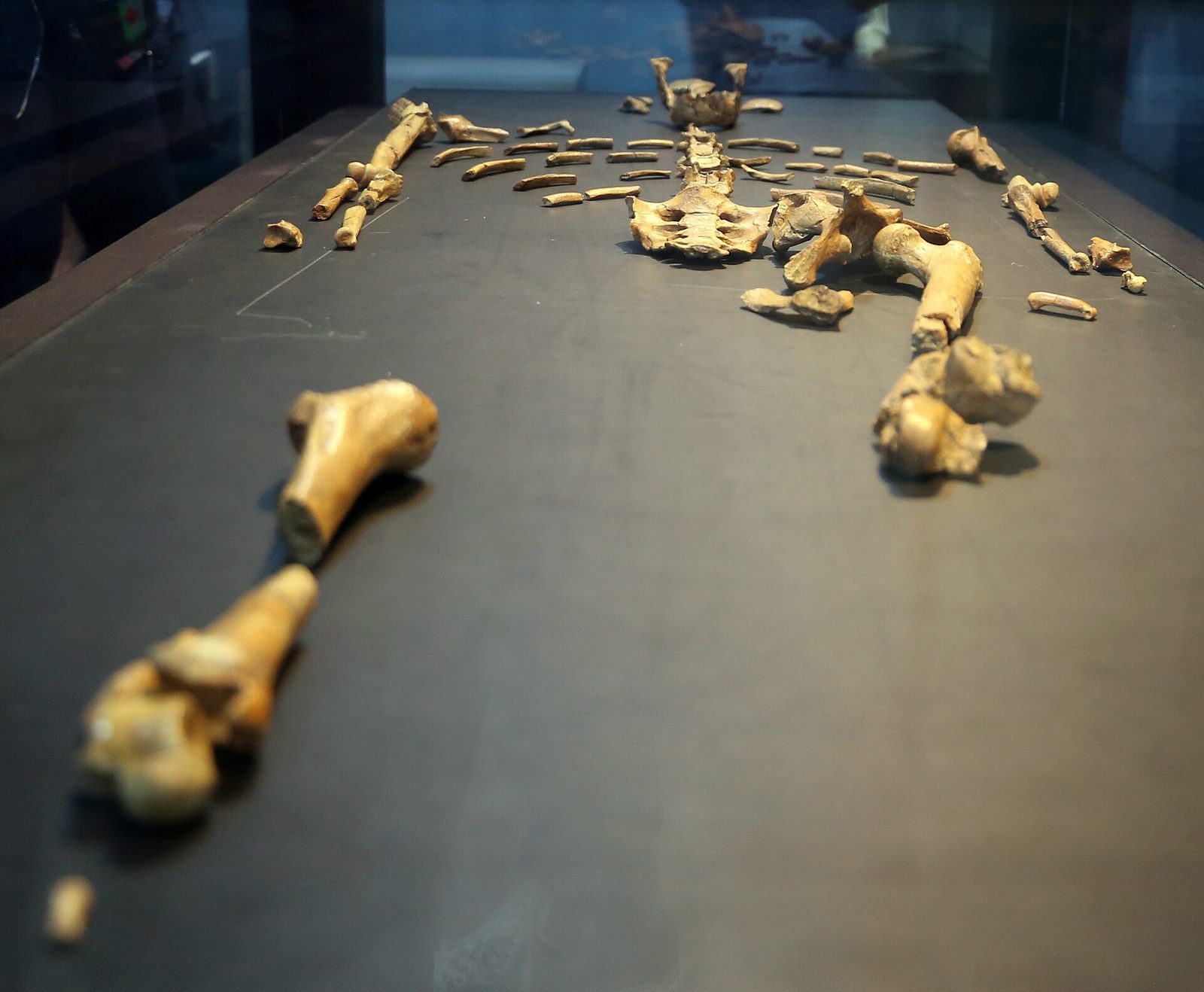
It was midday at Hadar, in the Afar region of Ethiopia, and very hot. Donald Johanson and his graduate student Tom Gray had been out mapping where they had found a pig skull, and they were tired and walking back to the Land Rover. Then Johanson glanced over his right shoulder and saw a small piece of elbow on the slope.
He knew at once it was not from a monkey or an antelope. Looking further up the slope he saw more: part of a thigh bone, pieces of jaw, fragments of skull. It was 24 November 1974. Johanson told ASU News, Arizona State University’s news service, that it had taken two months in the field to find it. “But there at my feet was my childhood dream,” he said.
A song in camp, and a second name
That night, the team played the Beatles’ “Lucy in the Sky with Diamonds” in camp. Someone suggested the name and it stuck, according to Johanson’s account and the Cleveland Museum of Natural History, where he was once curator of physical anthropology. The official label is AL 288-1.
In Ethiopia she has another name, Dinkinesh. Johanson also pointed out a coincidence of dates: 24 November was the day in 1859 that Darwin’s On the Origin of Species was published.
Johanson did not work alone. Smithsonian Magazine describes the find as made by a team led by Maurice Taieb, Donald Johanson and Yves Coppens. The species she belongs to, Australopithecus afarensis, was formally named in 1978.
What one small skeleton showed
Lucy stood about 1.06 metres (3ft 6in) tall and lived about 3.2 million years ago. Her teeth show she was an adult. At the time she was the oldest and most complete early human relative ever found.
Her importance is in her hips and legs. The Cleveland Museum explains that her thigh bone angles in from hip to knee, as ours does, which helps balance on two legs; a chimpanzee’s is straighter. So Lucy walked upright, and the museum says her bones show that early human relatives walked on two legs before large brains developed. That overturned the old idea that a big brain came first.
She probably also climbed. Smithsonian Magazine notes that her species had long arms and curved fingers suited to trees, and divided its time between the ground and the branches. Nobody knows what killed her. A fall from a tree is one possibility, and a carnivore’s tooth mark on her hip suggests her body was scavenged.
“Lucy is one of the first celebrity fossils,” the science historian Lydia Pyne told Smithsonian Magazine. Nearly 500 specimens of her species have been collected since, ASU says, and a more complete child of the same species, nicknamed Selam, was found in 2000.
Where the accounts differ
Read four reputable accounts and the details do not quite line up.
- How much survives. ASU and the Cleveland Museum say about 40 per cent of the skeleton. The National Museum of the Czech Republic says about 25 per cent, or 47 bones. None of the pages explains how it counted.
- Her age at death. ASU says she probably died at about 9 or 10, because her species grew up faster than we do. The Czech museum says 12 to 16. Both agree she was fully grown.
- What Dinkinesh means. The Cleveland Museum and Mark Maslin of UCL translate it from Amharic as “you are marvellous”. The Czech museum gives “you are beautiful”.
- The name. ASU says the song was playing on the night of the find; the Cleveland Museum says the team “reportedly” named her after it.
The travelling skeleton
The real bones are kept at the National Museum of Ethiopia in Addis Ababa. They rarely leave. The Czech museum says the originals had been abroad only once before 2025, on a tour of the United States from 2007 to 2013. They were shown in Prague for 60 days from August 2025, the first time in Europe, and then at the new Natural History Museum Abu Dhabi, which, Maslin wrote in June 2026, was due to return them to Addis Ababa in July.
Most people meet Lucy as a cast. The Cleveland Museum made the first casts of her bones, and most of the casts in museums around the world were made from those.
If you enjoy discoveries made by people looking for something else, read how four friends found the painted cave of Lascaux. If you would like to find something old yourself, start with fossil hunting for beginners.
Sources
- Lucy's lasting legacy: Donald Johanson reflects on the discovery of a lifetime — ASU News, Arizona State University (Julie Russ), 21 November 2024
- A groundbreaking discovery turns 50: celebrating the story of Lucy — Cleveland Museum of Natural History (Anna Alger), 24 November 2024
- What Lucy, one of the world's most important fossils, has taught scientists in the 50 years since her discovery — Smithsonian Magazine, accessed 29 October 2026
- The original fossils of Lucy and Selam are on display for the first time in Europe — National Museum of the Czech Republic, 25 August 2025
- Comment: Three million years after she walked upright, Lucy has made another journey — UCL News (Mark Maslin and Peter Kjærgaard, first published in The Conversation), 24 June 2026
- Human Evolution gallery — Natural History Museum, London, accessed 29 October 2026
- Virtual lab: afarensis pelvis — John Hawks Laboratory, University of Wisconsin–Madison, accessed 29 October 2026
Quotes are taken from the sources above. We link to the original reporting so you can read the full story.
Was this one for you?