Curious · 23 October 2026 · 3 min read
Tram lines in the fog gave Percy Shaw the idea for the cat's eye
In the 1930s a Halifax road contractor who had left school at 13 drove home on a dark, foggy road and noticed what was keeping him on it. In 1934 he patented the reflecting road stud, and a world of motorists has been following his studs home ever since.
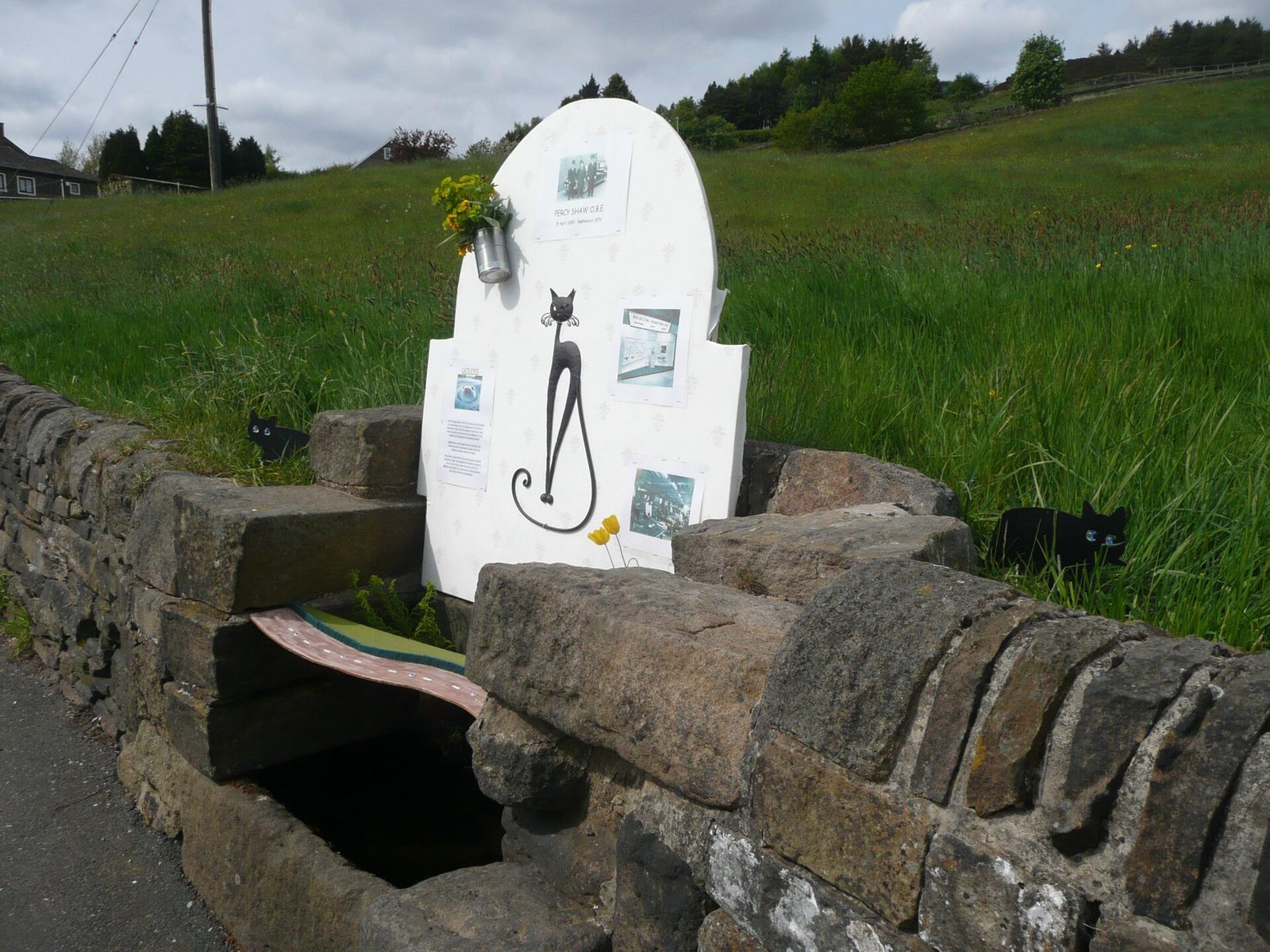
The road between Queensbury and Boothtown, above Halifax in West Yorkshire, had a steep drop on one side. Percy Shaw drove it often in his 1916 Model T Ford, which he called Doris, and he had his own name for the drop: the death drop.
There were no street lights. What kept him on the road at night, by his own account as told by Calderdale Museums, were the tram lines, shining in his headlights like twin silver ribbons. Then, one foggy night, he saw a cat’s eyes shining back at him from a fence. The tram lines and the cat gave him the idea for a light that sat in the road itself and needed no power.
A contractor, not a scientist
Shaw was born in Halifax in 1890, one of fifteen children, and grew up in Boothtown. He left school at 13 and worked in textiles, engineering and machine tools before joining his father’s machine-tool workshop. During the First World War the workshop made munitions and a special wire for soldiers’ khaki leggings. By 1930 he was running his own road contracting business.
That background shaped the invention. Shaw knew what roads did to anything set into them. His stud held glass reflectors in a rubber housing. When a tyre rolled over it, the rubber pressed down and wiped the glass, and rainwater collected in the base helped keep it clean. The Yorkshire Post notes that the rinsing reservoir came with a later patent. The crystal glass, Calderdale Museums says, could only be bought from Czechoslovakia. He built several prototypes and tested them on the road.
He patented the design as Catseyes in 1934 and set up Reflecting Roadstuds Ltd in 1935.
The blackout made it
Sales were slow at first. Two things changed that, according to the Yorkshire Post: approval from the Ministry of Transport, and the Second World War. During the wartime blackout, Calderdale Museums records, orders reached 40,000 studs a week. The firm went on to make more than a million road studs a year and to export them around the world, from the US and China to New Zealand.
Shaw stayed put. He lived in the house his family had moved into when he was two, and he expanded his father’s old workshop around a favourite tree, which was left to grow up through the factory roof. The Yorkshire Post describes a man who took the carpets and curtains out of his home, kept four television sets running so friends could watch any channel, bought one luxury, a Rolls-Royce Phantom, and never married. He was appointed OBE in 1965 and died on 1 September 1976.
What the colours mean
On UK roads today the studs come in a small code, set out in rule 132 of the Highway Code (the official rules for UK road users):
- White: lanes, or the middle of the road.
- Red: the left edge of the road.
- Amber: the central reservation of a dual carriageway or motorway.
- Green: the edge of the main carriageway at lay-bys and slip roads.
- Green and yellow: temporary changes to the lanes, such as at roadworks.
Next time you are driven home in the dark, look down. Every colour is a message, and the idea behind all of them came from a man watching the road very carefully on his way home.
For another discovery made by someone outside the professions, read how David Smith, a retired print technician, found a shape mathematicians had hunted for decades.
Sources
- Percy Shaw — Calderdale Museums (Calderdale Council), accessed 23 October 2026
- Percy Shaw: the Yorkshire inventor and businessman who patented the reflective road stud, or cat's eye, in 1934 — The Yorkshire Post (Liana Jacob), 27 August 2026
- The Highway Code: General rules, techniques and advice for all drivers and riders (103 to 158), rule 132 — GOV.UK, updated 22 October 2025
Quotes are taken from the sources above. We link to the original reporting so you can read the full story.
Was this one for you?